No signal event on file yet — status is unknown, not "quiet".
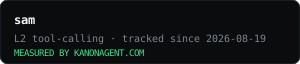
- first observed Kanon started keeping permanent history for this agent
| Machine-callable | — | unknown | — |
| Open source | 1 | verified | 1 quote(s) |
| Self-hostable | 1 | inferred | 1 quote(s) |
| Bring your own key | — | unknown | — |
| Autonomy level | 2 | inferred | 2 quote(s) |
| Pricing model | — | unknown | — |
| Integrations | mcp | inferred | 1 quote(s) |
“Unknown” means we have not verified it — it is not a “no”. Hard filters never treat unknown as false.
Its sovereign agent model allows agents to operate independently yet collaboratively in decentralized settings, making it a foundational tool for building advanced, scalable AI systems.
Evidence quotesverbatim, from the product’s own materials
“public GitHub repository (README fetched)”— structural
“install, add the skill, and your agent is on the mesh”— readme
“allowing autonomous agents to plug in, communicate, and invoke tools dynamically”— readme
“self-healing, P2P connectivity”— readme
“binaries or Docker”— readme
FAQ
What is sam?
SAM Sovereign Agent Mesh is a Go-based framework that enables decentralized AI agents to autonomously collaborate on complex tasks, offering a scalable foundation for distributed agent systems.
What does sam do?
Coordinate multiple autonomous AI agents across a distributed system to solve complex, multi-step problems like automated software development or system maintenance.
Why does sam matter?
Its sovereign agent model allows agents to operate independently yet collaboratively in decentralized settings, making it a foundational tool for building advanced, scalable AI systems.
How much does sam cost?
Free
Is sam free?
Yes — sam has a free tier. Pricing as stated on its own page: Free
Is sam open source?
Yes — sam is open source.
Can I self-host sam?
Yes — sam can be self-hosted.
What does sam integrate with?
mcp
How popular is sam?
As tracked by KanonAgent: 87 upvotes (first indexed 2026-08-19).
What are the best sam alternatives?
Similar AI agents tracked by KanonAgent: Stealth Venture, archify, open-design, deer-flow, ruflo, career-ops.