No signal event on file yet — status is unknown, not "quiet".
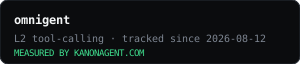
- first observed Kanon started keeping permanent history for this agent
| Machine-callable | — | unknown | — |
| Open source | 1 | verified | 1 quote(s) |
| Self-hostable | — | unknown | — |
| Bring your own key | 1 | inferred | 1 quote(s) |
| Autonomy level | 2 | inferred | 3 quote(s) |
| Pricing model | — | unknown | — |
| Integrations | — | unknown | — |
“Unknown” means we have not verified it — it is not a “no”. Hard filters never treat unknown as false.
It acts as a foundational operating system for complex AI workflows, offering strong ecosystem potential through standardized agent collaboration.
Evidence quotesverbatim, from the product’s own materials
“public GitHub repository (README fetched)”— structural
“A first-party API key, a Claude/ChatGPT subscription, or any compatible gateway. All first-class.”— readme
“enforce policies and sandboxing”— description
“custom agents (defined in YAML)”— readme
“Sessions follow you: start in your terminal, continue in the browser”— readme
“Omnigent is an open-source meta-harness that gives you a common orchestration layer over Claude Code, Codex, Cursor”— readme
FAQ
What is omnigent?
Omnigent is an open-source framework that coordinates multiple AI agents—like Claude Code, Codex, and Cursor—enabling them to work together on complex development tasks with controlled policies and real-time collaboration.
What does omnigent do?
To orchestrate multiple AI agents to collaboratively complete complex development workflows such as code generation, testing, and deployment.
Why does omnigent matter?
It acts as a foundational operating system for complex AI workflows, offering strong ecosystem potential through standardized agent collaboration.
How much does omnigent cost?
Open-source (free)
Is omnigent free?
Yes — omnigent has a free tier. Pricing as stated on its own page: Open-source (free)
Is omnigent open source?
Yes — omnigent is open source.
How popular is omnigent?
As tracked by KanonAgent: 28 upvotes (first indexed 2026-08-12).
What are the best omnigent alternatives?
Similar AI agents tracked by KanonAgent: Stealth Venture, taste-skill, archify, open-design, deer-flow, ruflo.